
Why I stopped waiting for clean financials and built booq
After graduating from Vlerick, my goal was to enter the financial industry and use what I had learned to make an impact in the business world. No better place to start, I thought, than Private Equity. At CNBB, I spent the past five years on the buy-side, deciding whether to invest serious money into tech companies.
The job is often described as judgment. In practice, a lot of it is waiting. Waiting for clean financials to arrive, after sending the fourth follow-up request. Waiting for a monthly P&L that has been re-cut three times by three different people, reconciling to none of the data previously received. Waiting for answers on Q&A items to actually explain what's behind these numbers.
You learn quickly that in a transaction, analysing and presenting the numbers are never the hard part. The hard part is getting to numbers you can actually trust. Because the quality of your decision is capped by the quality of your data. You can build the cleanest decks and models on top of bad data, but all you've done is make guesses look substantiated and precise.
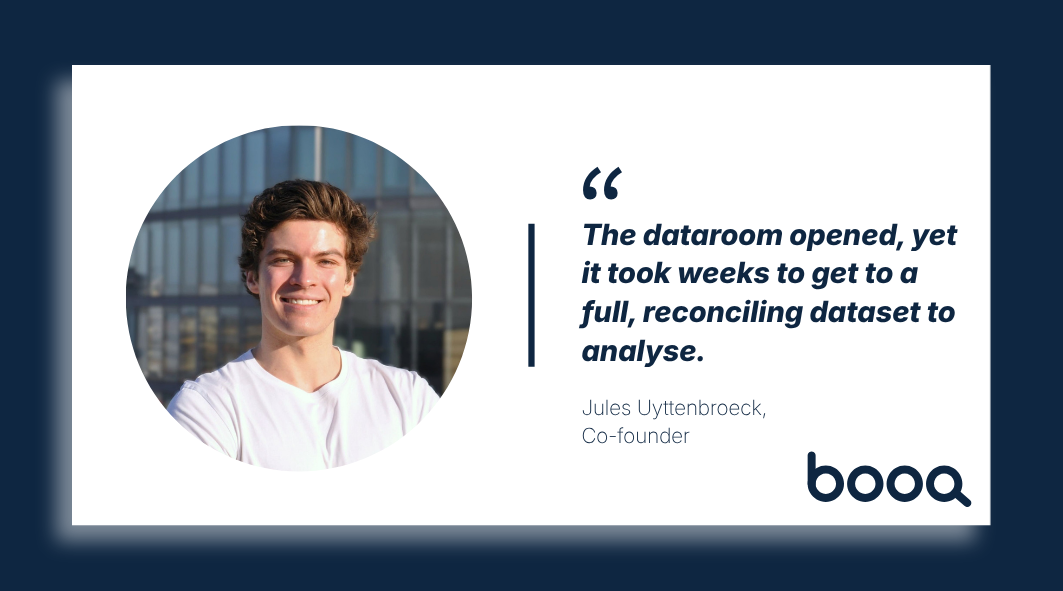
Not long ago, I worked on a deal that didn't close. The dataroom opened, yet it took weeks to get to a full, reconciling dataset to analyse. What came out the other end didn't match what the sell-side had presented. And the uncomfortable part: they didn't know. Nobody had been hiding anything. Their numbers had simply never been assembled in a way for anyone to see the full picture accurately.
The peculiar part is that nobody thinks this way of working is broken. It's just the job. Financial due diligence runs the same way it did twenty years ago: Excel, a VDR, and an endless follow-up and Q&A loop. Even though the underlying data has become fully digital since, we still export it into fragmented spreadsheets, only to painstakingly rebuild it by hand on the other side of the table.
Not closing that transaction was the correct outcome but it still landed less like a win than a near miss. And an expensive one at that, for everyone involved. That was the moment I thought to myself: this cannot be the way this gets done anymore. A couple of months later, I was out. It was time to build something.
With booq my team and I are building the product I wish existed all along: financial data infrastructure for modern M&A. The financials already exist. The problem is structurally getting them into a form that all transaction stakeholders can actually trust and work from. booq is built to create that foundation: one clean, complete dataset for the transaction, with the tools to analyse and present it on either side of the table. Instead of every party rebuilding and reconciling the numbers for themselves, everyone can work from the same underlying data - complete and trustworthy by design, rather than by gruntwork.
The goal is simple: less time getting to the numbers and more time deciding what they mean.